We are pleased to announce that part of our trail will follow the POHORJE KOZJAK trail, which the BBC has ranked among the 5 most anticipated trails in the world, and which also features the following trails:
- ROCKY TO NORDEGG RAIL TRAIL, CANADA
- KING CHARLES III ENGLAND COAST PATH, ENGLAND
- EAST MALLORCA GR-226, MALLORCA
- DONGSEO TRAIL, SOUTH KOREA
The trail is not technically demanding, so active hikers can complete it without any particular difficulty. The trail will officially open in June; it is 174 kilometers long and divided into 20 stages.
“While many hikers in Slovenia beeline to the Julian Alps in the country’s north-west, the Pohorje-Kozjak Trail, scheduled to open in June, encourages adventurers to discover the country’s less-crowded eastern corner,” as reported by a well-known online portal, which went on to say that the route “passes through a primeval forest, crosses ski slopes, skirts waterfalls and summits the path’s highest peak, the 1,543m-tall Črni vrh (Black Peak).”
Since we haven’t yet heard about this development—at least in Ljubljana—despite the fact that an attractive website is already available where detailed descriptions and maps of the stages can be found, we turned to Karmen Razlag, head of the tourism sector at the Regional Development Agency for Podravje – Maribor, with our questions. She explained that the BBC feature is the result of systematic cooperation with international media. “The BBC article was written by journalist Alex Crevar, who is very familiar with the broader Alpine-Adriatic region. This is an important international endorsement of the trail’s potential. Being ranked among the most anticipated hiking trails of 2026 holds great promotional value and confirms that the Pohorje–Kozjak Trail has a story that transcends local boundaries,” she said. The agency has already received many congratulations simply due to the publication on this British online portal, but they do not intend to stop there, as they are preparing to present the trail on major international outdoor platforms in the coming weeks and months.
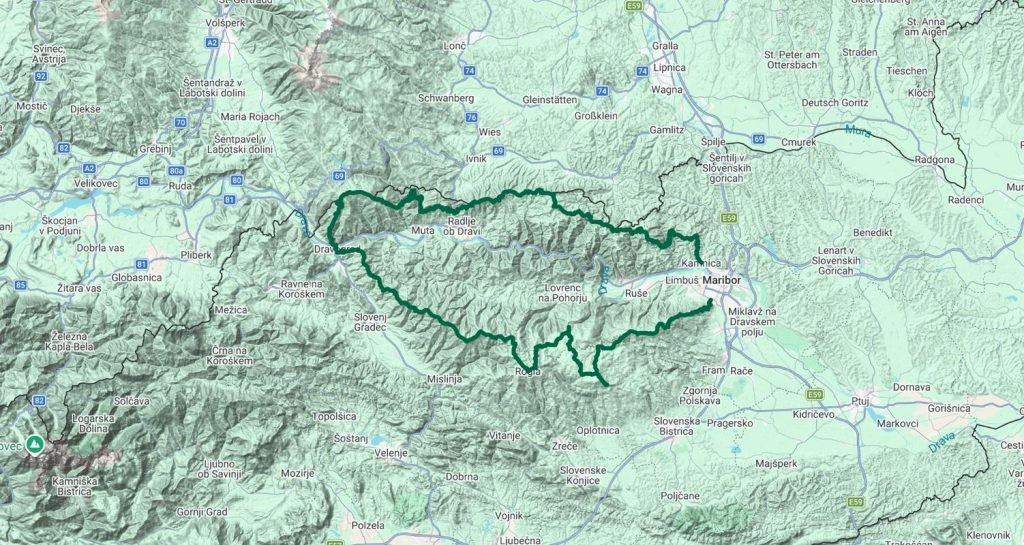
10 sections across Pohorje, 10 across Kozjak
The Pohorje–Kozjak Trail will officially open in June in Maribor, which is also the starting point of the Slovenian Mountain Trail. It will be presented to the general public at that time. The agency is still finalizing all the details, but its key figures are already known. It is a 174-kilometer circular hiking trail that starts in Maribor and connects the Pohorje and Kozjak mountain ranges. The trail is divided into 20 sections, 10 of which run through Pohorje (approximately 85 kilometers) and 10 through Kozjak (approximately 97 kilometers), with the total walking time estimated at 59 hours. The paths mostly follow existing and officially marked hiking trails under the wing of the Slovenian Mountaineering Association, and in cooperation with mountaineering clubs, they will be further marked and upgraded as a unified hiking product. The trail can already be walked in its entirety prior to the official opening.
The idea for the trail originated within the Partnership for Pohorje, where the development of Pohorje and Kozjak is coordinated by the Podravje – Maribor Regional Development Agency. “We drew inspiration from successful Slovenian and international models, but we adapted the product to the character of our region. After establishing and marking more than 720 kilometers of cycling routes in recent years, we are continuing our development efforts this year in the field of hiking as well. The Pohorje–Kozjak Trail is thus one of the largest joint development projects of the Partnership for Pohorje in the field of hiking, through which we aim to connect Pohorje and Kozjak into a coherent whole—a circular hiking system based on experiencing nature, cultural heritage, and scenic viewpoints on both Pohorje, Kozjak, and along the Drava River,” emphasized Karmen Razlag. Special emphasis was also placed on a sustainable approach, which is why the trail follows existing infrastructure and does not interfere with sensitive natural areas.
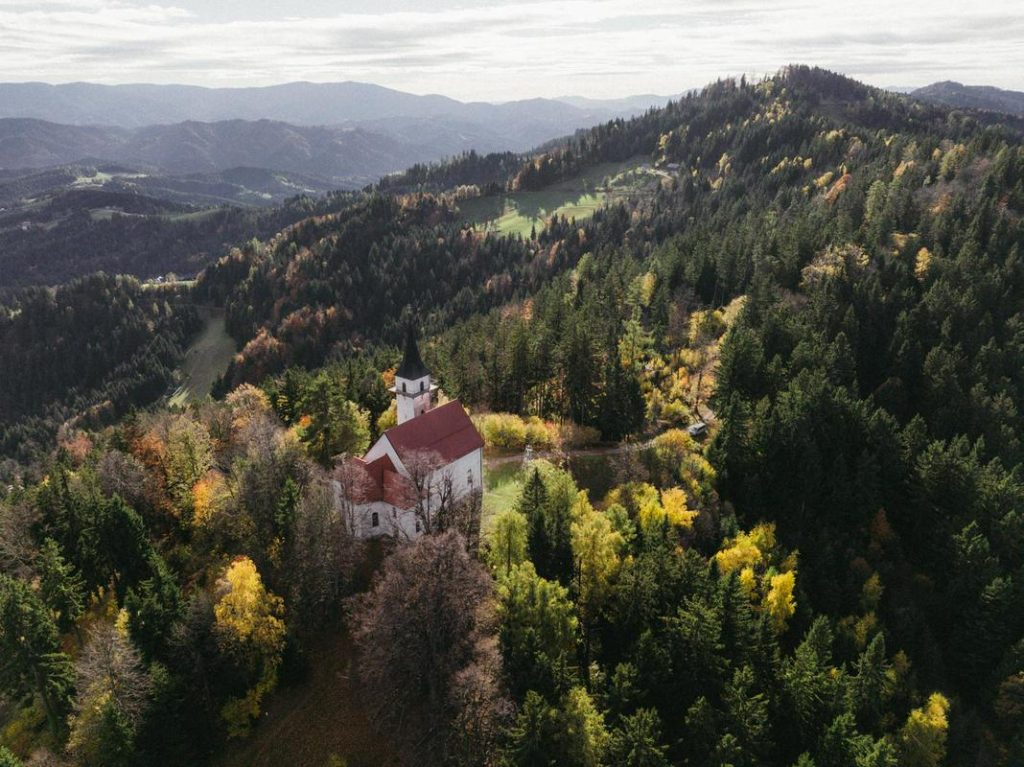
From day trips to multi-day hikes, from families to experienced hikers
The stages of the Pohorje–Kozjak Trail are designed to start and end at easily accessible locations, such as towns, tourist centers, or mountain huts. Several starting points are also accessible by public transportation (for example, Maribor, Zreče, Ruše, and Radlje ob Dravi), while others can be reached by car or bicycle. “In future development phases, we will also pay special attention to organized transfers between stages and improving connections to key starting and ending points,” added Razlag.
“The entire course is marked as a more challenging multi-day hiking trail, primarily due to its total length and the elevation gains of the individual stages. Technically, the trail is not difficult, so active hikers can complete it without any particular difficulty.” Karmen Razlag
Hikers can therefore “at their own pace,” day after day, complete all the stages as part of a hiking marathon, or choose only individual stages, which vary considerably in length—ranging from a good four kilometers, which can be covered in an hour and a half, all the way up to five-hour, 15-kilometer hikes. This way, there’s something for everyone—from more experienced hikers who can tackle challenging trails all day long to those with less stamina or families with young children.
“The entire route is classified as a more demanding multi-day hiking trail, primarily due to its total length and the elevation gains of the individual stages. Technically, the trail is not difficult, so active hikers can complete it without any particular difficulty. The individual stages vary in difficulty,” said Razlag. The following stages are suitable for families or less experienced hikers: Belvi–Maribor Hut–Ruška Hut, Maribor Hut–Skalca Waterfall, Maribor Hut–Ruška Hut, Rogla–the Lovrenc Lakes, Ribniška Hut–Kope, St. Jernej–St. Primož, and Kamnica–St. Urban. For more experienced hikers, the agency recommends combining different stages or choosing the Šumik Primeval Forest route with the Veliki and Mali Šum waterfalls, the Radlje–Remšnik route, and the Trije kralji–Klopni vrh course.
Along the way, there are more than 100 attractions of various kinds
Along the way, visitors not only get a good workout, but also learn something new while enjoying recreational activities and taking care of their health. In fact, more than 100 natural and cultural landmarks are marked along the various stages, offering visitors the chance to explore the rich cultural and natural heritage of both mountain ranges.
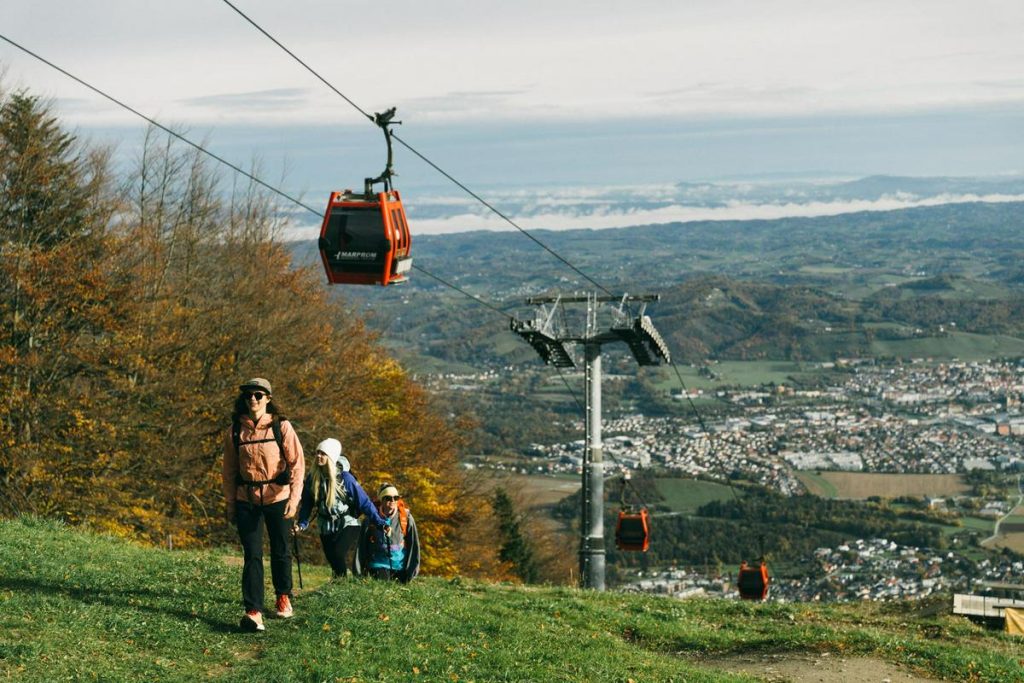
“Points of interest include: the starting point of the Slovenian Mountain Trail, the Habakuk and Poštela archaeological sites, the upper station of the Pohorje Funicular with the Bellevue complex, the Church of St. Bolfenk, the Maribor Lookout Tower, Skalca Waterfall (Framski Waterfall), the Church of St. Areha, Pri Bajgotu (Šumik), Šumik Waterfall, Urškin Cross, the Church of the Three Kings, the lake Črno Jezero Interpretive Trail, Črno Jezero, the observation tower on Rogla, Rogla with a wide range of amenities, the Lovrenc Lakes, Ribniško Lake, Črni vrh – the highest peak of Pohorje, the Kope tourist complex with a wide range of amenities, the highest peak of the Kozjak Mountains, hiking right along and on the state border between Slovenia and Austria, the border church of St. Urban on Kozji vrh, Kapunarjev vrh, Remšnik and the Church of St. George, the Church of St. Pancras with a viewing balcony, Odomovo Lake, Kapla on Kozjak, the Church of the Holy Spirit on Ostr vrh, the Church of St. Urban above Kamnica …”
The project thus represents not only a new hiking trail but also an important platform for cooperation among municipalities, mountaineering clubs, and tourism providers in the Pohorje and Kozjak regions, according to the Podravje–Maribor Regional Development Agency. For this reason, the greatest challenges in designing the Pohorje–Kozjak Trail were not of a technical nature, but rather involved coordination—specifically, how to connect 13 municipalities and several mountaineering clubs and unify the development vision between the two mountain ranges.
Pohorje is dotted with mountain huts and ski resorts, while Kozjak is quieter and more boutique-like
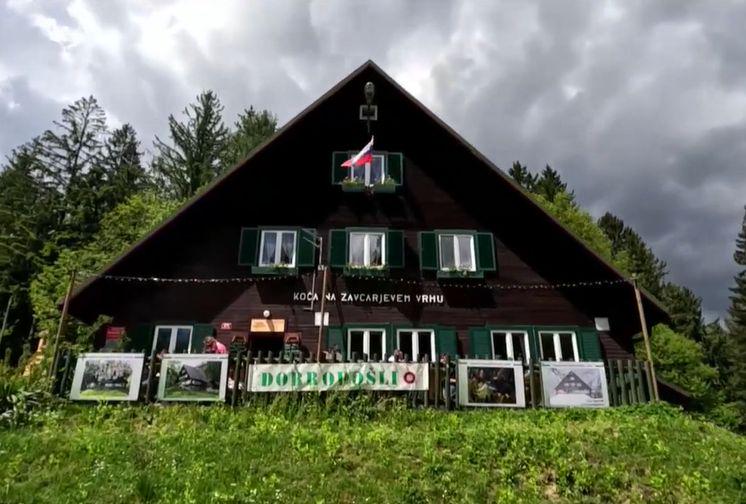
In the Pohorje section, hikers can stop for refreshments and rest at several mountain huts, such as the Mariborska Hut, the Ruška Hut, the Ribniška Hut, Hut on Pesek, and Hut under Kremžar peak; along the way, they also pass ski resorts at Belvi, Areh, Rogla, Three Kings, and Kopa. In the Kozjak section, there is less mountain infrastructure. The key huts are the Košenjak Mountain Hut and the Hut on Žavcar peak; options are also available through farm stays and private tourist accommodation providers in the vicinity of Urban, Tojzlov peak, St. Duh, as well as above Kapla or Radlje by Drava.
The number of visitors is growing steadily
When asked how many hikers they expect on the trail and whether, as expected, there will be more domestic or foreign visitors among them, Karmen Razlag replied: “We are seeing steady growth in tourism across the 13 municipalities of the Partnership for Pohorje. The number of tourist arrivals increased from 405,769 in 2024 to 431,302 in 2025, representing an increase of 25,533 arrivals, or approximately 6.3 percent. Overnight stays have also increased: from 974,217 in 2024 to 1,010,588 in 2025, representing a growth of 36,371 overnight stays, or about 3.7 percent. We will monitor trail usage based on overnight stay statistics, data from mountain huts, the number of GPX track downloads, and data from outdoor apps. We expect a mix of domestic hikers (weekend trips) and international visitors (multi-day hikes), particularly from the German, Austrian, Croatian, Hungarian, Polish, and Czech markets.”
This initiative could also be an important step toward greater international recognition of Pohorje as one of the leading hiking and outdoor destinations in this part of Europe, and they also hope to further establish Pohorje as an attractive year-round outdoor destination. “In recent years, numerous ski resorts in Slovenia and beyond have increasingly transformed into year-round outdoor centers due to climate conditions and the great potential for developing outdoor activities. The situation is similar in Pohorje, where we are becoming increasingly aware of the opportunities offered by year-round tourism development. Both larger centers and numerous smaller providers are developing new outdoor experiences, thereby enriching the offerings for visitors in all seasons. Pohorje is thus increasingly establishing itself as one of Slovenia’s leading outdoor destinations,” concluded our interviewee.
Article, images, and text adapted from MMC RTVSLO.SI; source HERE
Will the TRAIL MARIBOR eventually extend to 100 miles?
Let’s wait and see.